Although we initially said this was going to be a five-part series, well, things change. We had more information than we originally planned on – specifically for the next segment (Part IV) which addresses nutrition and supplements, and the importance that they play in your ongoing road to wellness. Part IV is now made up of three sub-segments: Part IV-a – which made the case for supplements in general; Part IV-b – THIS segment, in which we will discuss the kinds of supplements NOT to take; and Part IV-c – the next segment, which will address what supplements TO take. Part V will then address re-evaluation and hear from some of our satisfied patients.
But I Take a Daily Multi-Vitamin – Isn’t That Good Enough?
 In a word – NO! In two words – HECK NO!
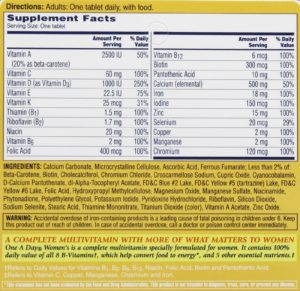
So why isn’t it good enough? Let’s look at the ingredients on a label taken from a popular multi-vitamin for women. Most people have heard that most of a multi-vitamin is expelled from the body, undigested and unabsorbed. That may be true in cases when we overdose on a water soluble vitamin. However, did you ever wonder why this happens with some vitamins even when we are NOT over dosing – especially since we actually need vitamins and minerals? Why would our body eliminate the very things we actually need?
First, we need to look at the quality of the nutrients in the product. Some vitamin and mineral forms are harder for us to absorb and for us to use. They are not bioavailable! While this is true – things get even worse. In a lot of cases, what is listed as a vitamin really isn’t a vitamin. Let’s take the very first item on the label – Vitamin A (20% as beta-carotene). Pretty innocuous, right? They’re telling me that the Vitamin A in this supplement is in the form of beta-carotene, right? Wrong! Yes, beta-carotene is in this supplement. But beta-carotene is NOT Vitamin A! Beta-carotene is a potential precursor to Vitamin A – meaning that your body converts it into Vitamin A. “So, what’s wrong with that?” you ask. Plenty.
First, absorption is an issue. The absorption rate of beta-carotene is only 20-40% that of Vitamin A, and it is well established that the more beta-carotene a food contains, the less it is absorbed and converted to Vitamin A. FDA regulations, though, allow beta-carotene to be listed as if it were actually Vitamin A – without mentioning the lower absorption rate. As such, 2500IU (international Units) of beta-carotene has nowhere near the nutritive value as 2500IU of true Vitamin A. Second, many common health conditions interfere with the conversion of beta-carotene to Vitamin A, including:
- Diabetes
- Low thyroid function
- Low fat intake
- Nutritional deficiencies of zinc or protein
- Celiac disease
- Absent gallbladder
(Source: Rheaume-Bleue, BSc, ND, Kate Vitamin K2 and the Calcium Paradox: How a Little-Known Vitamin Could Save Your Life, Retrieved from www.books.google.com)
As a supplement, synthetic beta-carotene is usually “stabilized” in refined vegetable oils. In this trans fatty acid form, oxidation occurs and the chemically “pure” beta-carotene can no longer act as a nutrient, because it was changed. Almost all synthetic beta-carotene is produced by the Swiss drug giant, Hoffman-LaRoche. This form can no longer be converted into vitamin A. The best it can be is worthless, and the worst is toxic.
(Source: The Doctor Within, Natural Whole Food Vitamins: Ascorbic Acid is Not Vitamin C. Retrieved from www.thedoctorwithin.com)
Now, let’s move to the second listing – Vitamin C. Vitamin C is almost always added as ascorbic acid, as is the case with this label. Note that ascorbic acid is the 3rd item in the ingredients section. As with beta-carotene vs. Vitamin A, ascorbic acid is not Vitamin C.
Ascorbic acid is an isolate, a fraction, a distillate of naturally occurring vitamin C. In addition to ascorbic acid, vitamin C must include rutin, bioflavonoids, Factor K, Factor J, Factor P, Tyrosinase, Ascorbinogen, and other components. In addition, mineral co-factors must be available in proper amounts in order to have vitamin activity. If any of these arts are missing, there is no vitamin C, no vitamin activity.
For decades, over 90% of ascorbic acid in this country was manufactured at a facility in Nutley, New Jersey, owned by Hoffman-LaRoche, one of the world’s biggest drug manufacturers. Here ascorbic acid is made from a process involving cornstarch and volatile acids. Most U.S. vitamin companies then buy the bulk ascorbic acid from this single facility. After that, marketing takes over. Each company makes its own labels, its own claims, and its own formulations, each one claiming to have the superior form of vitamin C, even though it all came from the same place, and it’s really not vitamin C at all.
(Source: The Doctor Within, Natural Whole Food Vitamins: Ascorbic Acid is Not Vitamin C. Retrieved from www.thedoctorwithin.com)
Let’s move to vitamin E. In the ingredients section, vitamin E is represented by dl-alpha-tocopherol acetate. The dl- prefix is the give-away that this is a synthetic form.
Most studies show that synthetic vitamin E is only half as active in the body as the natural form.
(Source: Falloon, William (2009, April), Dietary Supplements Under Attack In Life Extension Magazine. Retrieved from www.lifeextension.com)
In addition, following the same tack as our vitamin A and vitamin C discussions – alpha-tocopherol is but one component of vitamin E.
Vitamin E is an entire complex of compounds including alpha-, beta-, and gamma-, and delta-tocopherol as well as multiple other compounds. The FDA, in its infinite wisdom, determined that the primary compound in vitamin E was alpha-tocopherol, and voila! Alpha-tocopherol now equals vitamin E. And alpha-tocopherol is cheap. However, an excellent vitamin E supplement must have the correct mix of tocopherols and tocotrienols in order to be effective.
(Source: Smart Publications: Clarifying the World of Nutrition Science, Are You Taking the Wrong Vitamin E? Get the Facts on Vitamin E Tocopherols. Retrieved from www.smart-publications.com)
We could go on and on about synthetic vitamins, but let’s move on to the “INGREDIENTS” section. What is this stuff? Well……:
- Calcium Carbonate: Also known as chalk, like what you use to write on a chalkboard. Didn’t teachers tell us not to eat chalk? Also made from ground-up limestone. Yes – ground-up rocks.
- Microcrystalline Cellulose: Commonly known as WOOD PULP. Yes – wood pulp. Maybe that’s a newly discovered “Vitamin W”?
- FD&C Blue #2: A dye that was included in a 2007 study reported by D. McCann and colleagues in the journal “The Lancet”, which linked food colorings including Blue #2 to hyperactivity. A group of studies reviewed by the Center for Science in the Public Interest also showed that Blue #2 resulted in significant increases in brain cancers and other abnormal cell development in lab rats. Source: LIVESTRONG.COM.
- FD&C Yellow #5: An artificial coloring derived from coal tar, that has been reported to lead to “allergic or adverse reactions, such as urticaria (hives), eczema, angioedema, asthma, and hyperactive behavior.” Source: com.
- FD&C Yellow #6: Benzenesulphonic acid, treated with hydrochloric acid and sodium nitrite, banned in Norway and Finland, with reported side effects of gastric upset, diarrhea, vomiting, nettle rash (urticarial), swelling of the skin (angioedema) and migraines, and linked to hyperactivity in children. Source: com. I guess FD&C #5 by itself wasn’t enough.
- Hydroxypropyl Methylcellulose: More wood pulp. Specifically, from pine or poplar, which obviously makes it better.
- Polyethylene Glycol: A laxative, marketed under the brand name Miralax®. Seriously? It’s probably there to help all the wood pulp go through your system.
- Silicon dioxide: Beach sand. Enough said.
- Stearic acid: A fatty acid used to harden candles, to produce soap, and in lubricants, defoamers, and cold cream. Source: com. Apparently, spontaneous foaming of vitamins while in your medicine cabinet is a serious problem. Who knew?
- Titanium dioxide: A coloring most often found in sunscreens and makeup. It is classified as “expected to be toxic or harmful” on the “Environment Canada Domestic Substance List”. Source: EWG’s Skin Deep Cosmetics Database ewg.org/skindeep.
- Zinc Oxide: Widely used as an additive in numerous products “including rubbers, plastics, ceramics, glass, cement, lubricants,paints, ointments, adhesives, sealants, pigments, foods, batteries, ferrites, fire retardants, and first-aid tapes.” Source: com. It also promotes the healing of chapped skin and diaper rash. I’m really trying to come up with a legitimate reason why this is in a multivitamin…… but…… no.
Even if all these additives, specifically colorings, were safe – how much dye do you really need? Do you really care what color your vitamins are? I know I don’t. (Aren’t they all some boring beige-like color anyway?) Now, there are other ingredients in this particular vitamin that either aren’t helpful or are not good for you – but I’ll stop here because I think you get the drift.
The obvious take-away here is that we need to be not just concerned – but hypervigilant – about what we ingest. Clearly the pharmaceutical companies aren’t! Ingesting substances like those listed above that can be poisonous doesn’t help – it actually conflicts with the basic foundation of nutrition – that being that our cells need to be fed properly. Our bodies are pretty amazing – but when it comes to processing fuel, things are pretty black-and-white, friend-or-foe, good-or-bad. When our bodies cannot recognize the Franken-foods that we eat as valuable nutrition, they have to expend precious energy trying to destroy the “toxic invaders”. And that is, as one of my favorite TV characters – Lucas Black as Christopher LaSalle in NCIS-New Orleans – says, “no bueno.”
When you come to Nature’s Balance Acupuncture and Wellness Center, the purpose is to implement some sort of change – and that cannot be sustained without a sturdy foundation. If you are not willing to focus attention on what you put in your mouth, the changes we make cannot, and will not, last long.
Conclusion
So, now you know what NOT to take. Stay tuned for our next segment: I Think I’m Sick – Now What? Part IV-c: You Are What You Eat – Supplements to Help You, Not Kill You.
Interested in how we might be able to help you achieve optimal health? Visit our Facebook page for more tips and client testimonials, or give us a call at 815.788.8383!