When you come in for your first acupuncture treatment, you will be shown to a private treatment room, where you will lay down on a nice, comfortable, heated bed. You will hear soothing music, and you’ll be encouraged to breathe slow and deep to help you relax.
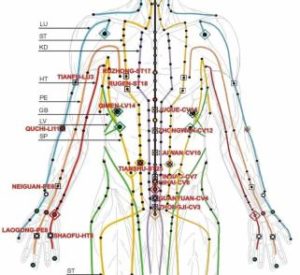
Meridians used in Chinese Medicine – From Nott Magazine http://www.nottmagazine.com
During your actual treatment, one of our acupuncturists will insert very small, sterile needles into very specific places on your body. If you remember from previous postings, at the core of Traditional Chinese Medicine (TCM) is our Qi – the life force that flows through all of us. The 12 main pathways through which our Qi flows are called meridians – six Yin channels and six Yang channels – each corresponding to certain organs and organ systems. Along these meridians are very specific acupuncture points, and by inserting these tiny needles into these very specific acupuncture points, your Qi can be stimulated, and the all-important Yin-Yang balance can be restored. For even more info on meridians, here is a good site to visit: http://www.acos.org/articles/the-chinese-medicine-meridian-system/. OK, so… back to the treatments.
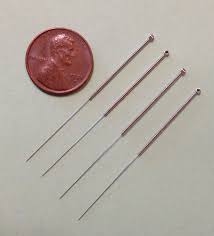
Acupuncture Needles
https://en.wikipedia.org
One of the first things many people ask is, “Will the needles hurt?” Check out the picture to the left. See how thin these needles really are? Many people say that they couldn’t feel anything at all when the needles were inserted. Focusing on the primary complaint and your marker as determined from your initial consultation, your acupuncturist will locate the appropriate acupuncture points and gently tap the needles in. After the needles have been inserted, your acupuncturist will turn off the lights so you can relax for the next 30-45 minutes.
During these initial 3-5 treatments, you will be asked to keep a journal. This part is extremely important, as it will play a pivotal role in your ongoing treatment plan. The main questions to address in your journal are:
- How did you do after treatment?
- What percentage did your marker improve?
- How long did it last?
- How long before it came back?
- What else changed?
The answers to these critical questions will allow us to determine what your ongoing treatment plan should entail. We will also give you some orientation materials, so you learn a little more about Chinese Medicine and what it can do. In addition, we will review with you what you want to achieve from your treatment. For instance, are you more interested in Relief Care – which generally means you achieve a level of function where your symptoms are gone for 3-4 weeks – or Corrective Care – where your treatments work toward restoring your body’s function permanently. More on your goals, timeframes, and treatment modalities in our next blog post; the focus at this point is to find out how your body responds to acupuncture, and to set the stage for the next stop in your journey to wellness.
Conclusion
So what comes next? That will be the topic of our next post: “I think I’m sick. Now what? – Part III: Your Treatment Plan”. After that, we’ll discuss diet and supplements. We’ll also hear from some of our past and present patients about their experiences with Nature’s Balance Wellness Center.
Interested in how we might be able to help you achieve optimal health? Visit our Facebook page for more tips and client testimonials or give us a call at 815.788.8383!